Group Structure on Loops
Fundamental Group
The fundamental group \newcommand{\R}{\mathbb{R}}\newcommand{\Z}{\mathbb{Z}}\pi_{1}(X,x_{0}) of a topological space at a base point is the group of homotopy classes of loops based at , with the multiplication of concatenation of loops, inverse being the reversed loop, and identity being the constant loop at .
Lemma
In , any two paths are homotopic if and only if they have the same endpoints.
Proof For any two paths and with same endpoints, gives a valid homotopy.
Proposition
.
Proof The ideal is that looks locally like . Define , , paths , , and , . Note that . We claim that sending integer to the homotopy class of forms the desired isomorphism. First show that it is a group homomorphism, i.e. . Define , . Observe that so . Note that both and are paths in from to , hence there exists a homotopy from to . Now let , then is a homotopy from to . This shows that is a homomorphism. Now we show the surjectivity. Fixing some loop . Define and . We can partition the preimage of as following: \begin{align} p^{-1}(S_{+})=\bigsqcup_{n\in\Z}\tilde{V}_{n},&\quad \tilde{V}_{n}=(n,n+1), \\ p^{-1}(S_{-})=\bigsqcup_{n\in\Z}\tilde{U}_{n},&\quad \tilde{U}_{n}=(n-1/2,n+1/2). \end{align}Then the restrictions of , say and are homeomorphism, with inverses and respectively. There is a partition of , with each either a subset of or a subset of . Now define satisfying , and then inductively on by where and are the unique integer for which or . This gives a path starting at and ending at some . Thus , hence, by applying to the both sides, and so . Finally, we show that is injective. Suppose , then , there exists a homotopy from to . Similarly, there exists a partition of , and , such that is either a subset of or a subset of . Now define similarly as above, which gives a homotopy from to , hence implies . Thus is injective.
Remark
In fact, the distributive law holds in general: Suppose is continuous, and are paths, then
Change of Basepoints
Proposition
Suppose is a path from to , then the map defined by is an isomorphism.
Proof We first check that it is well-defined. Suppose are homotopic paths of with homotopy . Then via .
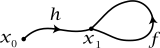 Secondly, it is a homomorphism because Moreover, is a inverse of (here means the reversed path), thus is an isomorphism.
Remark
Note that there is no ambiguity when we defined . Because actually .
Fundamental groups are powerful in many (other) realms of mathematics.
- It can even be used to prove the fundamental theorem of algebra: Proof For the sake of contradiction, suppose some non-constant polynomial has no roots. Then for each , is a loop in based at . Now fix some large . Then is a homotopy from to . Let . Define Note that since is sufficiently large is never zero, is a valid homotopy from to . Therefore, which implies since . This contradicts the assumption that is non-constant.
- We can also show Brouwer’s fixed-point theorem by the fundamental group. It states that any continuous has a fixed point, where is the closed disk in . Proof Suppose has no fixed points. Then we can define by sending to the intersect point of and the ray from to . Note that for . Consider the inclusion , we have via some homotopy . Then via , yielding a contradiction.