Exact Sequences
Let’s recall the definition of exact sequences in the context of abelian groups:
A sequence of morphisms between objects in an abelian category is exact at if . The sequence is an exact sequence if it is exact at every object.
Link to original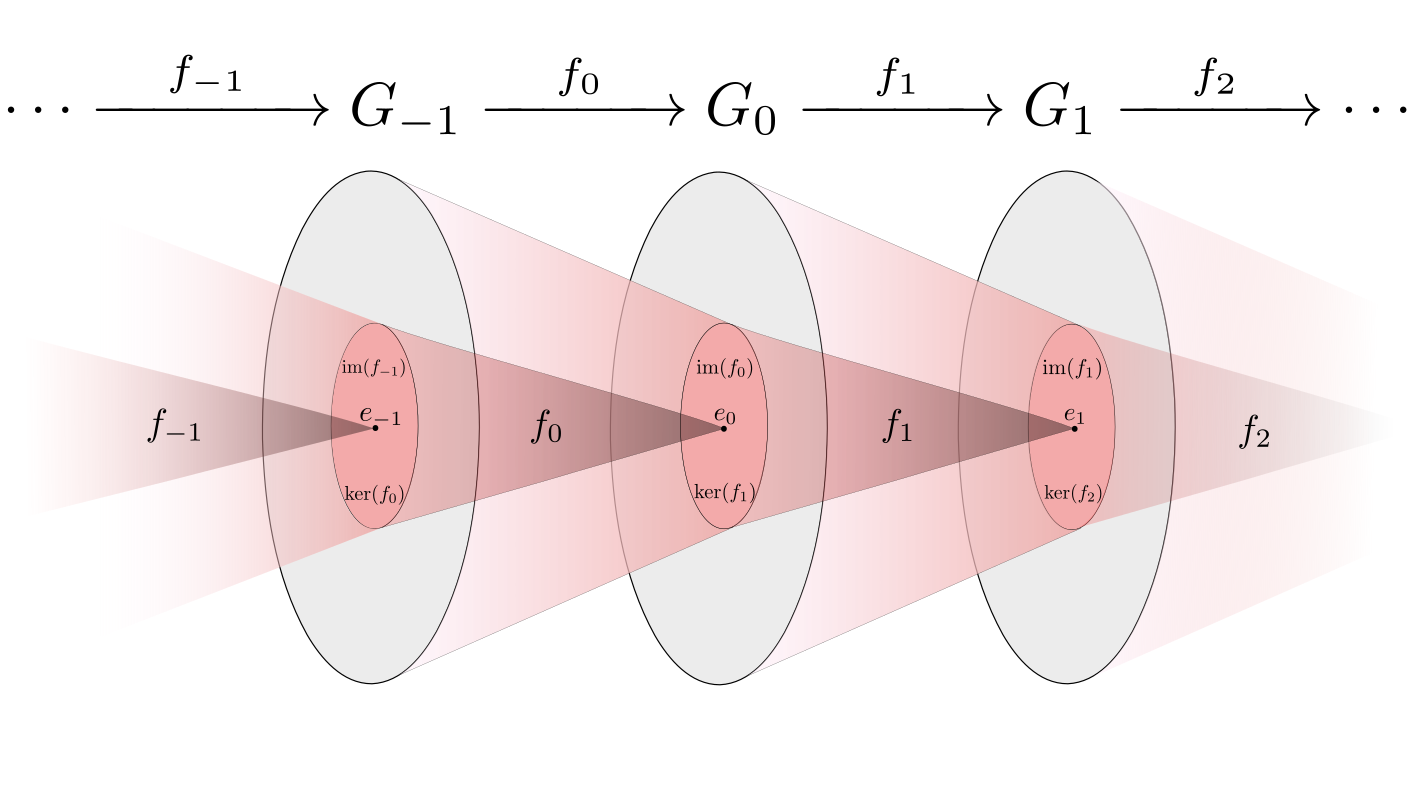
Short Exact Sequence
We call an exact sequence in form of as short exact sequence, more specifically with injective and surjective.
Theorem
For a short exact sequence , The sequence of homology groups is exact
Long Exact Sequence of a Good Pair
Good Pair
A pair with is called a good pair if is a non-empty closed subset of that has an open neighborhood which deformation retracts onto .
Long Exact Sequence of a Good Pair
For a good pair , there is a long exact sequence in homology: The maps are:
- : induced by the inclusion map .
- : induced by the quotient map .
- : the boundary map.
Optionally, we can write the sequence in reduced homology as: But note that is always reduced.
To prove this theorem we need the notion of relative homology.
Relative Chains and Homology
For any pair , the relative chain groups are defined as the quotient . The boundary map on induces a boundary map , turning it into a chain complex. The homology of this complex, denoted , is called the relative homology of the pair .
The long exact sequence of a good pair can be derived from the following:
Theorem
For any pair , there is a long exact sequence relating their homology groups:
is exact
The prove of this theorem directly follow prove of deriving long exact sequence from short exact sequence. We also have generalization for triple
Lemma
For a good pair , the relative homology is isomorphic to the reduced homology of the quotient space:
Excision Theorem
Given subspaces such that the closure of is contained in the interior of , then the inclusion induces isomorphism for all . Equivalently, for subspaces whose interiors cover , the inclusion induces isomorphisms for all n.
Applications
Corollary
The reduced homology of the n-sphere is given by:
Proof We will prove by induction on . Base Case (n=0): consists of two points, . . The reduced homology is and for . The formula holds. Inductive Step: Assume the formula holds for . Consider the good pair . The quotient space is homeomorphic to . The long exact sequence in reduced homology is: Since the disk is contractible, its reduced homology groups are all zero: for all . The sequence simplifies to: Exactness implies that the connecting homomorphism is an isomorphism for all . By the inductive hypothesis, is for (i.e., ) and otherwise. Therefore, the same is true for , completing the induction.
The long exact sequence can be used to prove Brouwer’s fixed point theorem for higher dimensions:
Brouwer's Fixed Point Theorem
Any continuous map has a fixed point.
Proof Assume there exists a map with no fixed points. We can then define a retraction by sending a point to the intersection of the ray from through with the boundary sphere (just like what we did here). Let be the inclusion map. The composition is the identity map. Note that is a good pair, so is an exact sequence. However, , and , so it is impossible to compose to the identity, yielding a contradiction.
Corollary
For a wedge sum , the inclusions induce an isomorphism , provided that the wedge sum is formed at basepoints such that the pairs are good.