-Complexes and Chains
Standard -simplex
The standard -simplex, denoted , is a subspace of defined as:
e.g. is a point; is a line segment; is a triangle; is a tetrahedron.
-Complex
A -complex is a topological space constructed by gluing together simplices ( for various ) along their faces. The gluing maps must be linear and preserve the ordering of vertices.
Remark
One can think of it as a more structured and restrictive type of CW complex, where the cells are specifically simplices and the attaching maps have stricter rules.
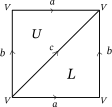
e.g. We can build a torus using a -complex structure with the following components:
- One 0-simplex: a single vertex, .
- Three 1-simplicies: edges .
- Two 2-cells: simplicies .
Imagine two triangles, and . We glue their corresponding edges to form a rectangle, and then identify the opposite sides of this rectangle to form the torus:
Chain Group
The -th chain group, , is the free abelian group generated by the set of -simplices in the -complex . An element of , called an -chain, is a finite formal sum of -simplices: , where and are -simplices.
Boundary Operator
We define a homomorphism, the boundary operator, . If we denote an -simplex by its ordered vertices , the boundary operator is defined by the alternating sum of its faces: where is the -face opposite the vertex . By convention, we set . i.e., .
e.g.
- Boundary of an edge (1-simplex): . This is the “endpoint minus the start point”. For a loop, where , the boundary is .
- Boundary of a triangle (2-simplex): . This represents the sum of the oriented edges forming the boundary of the triangle.
Simplicial Homology Groups
The boundary operator has a crucial property that allows us to define homology.
Lemma
The boundary of a boundary is zero. That is, the composition of any two successive boundary maps is the zero map:
Corollary
The image of is a subgroup of the kernel of : .
This relationship lets us define the homology groups, which measure the “holes” in our space.
Simplicial Homology Group
The -th simplicial homology group of , denoted , is the quotient group: The elements of are called -cycles, and the elements of are called -boundaries.
Remark
Homology captures the cycles that are not boundaries.
e.g. Recall our -complex structure for the torus :
The chain groups are: , , .
The boundary maps are:
- , , .
- Since all edges are loops starting and ending at , their boundaries are zero: , , .
:
- .
- .
- . This reflects the single connected component of the torus.
:
- , since the boundary of every 1-chain is 0.
- . This is the subgroup generated by .
- . We can use the relation to eliminate , leaving two independent generators, and . Thus, . These correspond to the two fundamental loops of the torus.
:
- : An element is in the kernel if . This implies . So, the kernel is the subgroup generated by the cycle .
- , since there are no 3-cells in our complex.
- . This represents the 2D “void” enclosed by the torus surface.