Procedure to Construct CW Complexes
CW Complex
A CW complex is a topological space constructed inductively from disks of increasing dimension. The construction proceeds as follows:
- Step (-skeleton): Start with a discrete set of points, , called the 0-cells.
- Step (-skeleton): Assuming the -skeleton has been constructed, the n-skeleton is formed by attaching -dimensional disks to via attaching maps , where is the boundary of . The space is the quotient space:
- Step (The full space): The CW complex is the union of all its skeletons, , endowed with the weak topology: a set is open (or closed) if and only if its intersection with every skeleton is open (or closed) in .
An n-cell refers to one of the disks attached at step . Specifically, is a closed n-cell, and its interior, , is an open n-cell. For each cell , the composition of the quotient map with the inclusion of the disk gives a characteristic map .
Why "CW"?
The C in CW stands for “closure-finite”, and the W for “weak” topology.
e.g.
- The sphere can be given a CW structure with:
- Two 0-cells: and . So the 0-skeleton is .
- Two 1-cells: and . The attaching map for sends the endpoints of to and , and the map for sends the endpoints to and . The 1-skeleton is two arcs joining and , forming a circle.
- Two 2-cells: and . These correspond to the two hemispheres. Their boundaries () are attached to the 1-skeleton. The attaching map for is , which traces the circular 1-skeleton. Similarly, the attaching map for is , which traces the same circle.
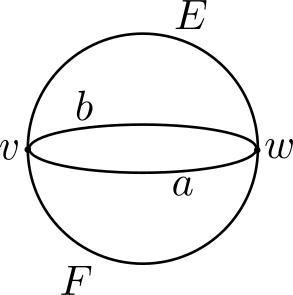
- The closed orientable surface of genus , , has a very economical CW structure:
- One 0-cell: .
- 1-cells: . The 1-skeleton is a wedge of circles.
- One 2-cell: . This single 2-cell is attached to the 1-skeleton. Its boundary is identified with the path given by the product of commutators:
Euler Characteristic
Euler Characteristic
For a finite CW complex (one with a finite number of cells), the Euler characteristic is defined as the alternating sum of the number of cells in each dimension: This generalizes the familiar formula for polyhedra.
e.g.
- For the 2-sphere , using the structure with 2 0-cells, 2 1-cells, and 2 2-cells: .
- For the genus surface , using the structure with 1 0-cell, 1-cells, and 1 2-cell: .
The Fundamental Group of a CW Complex
The CW structure is particularly useful for computing the fundamental group.
Proposition
Attaching cells of dimension does not change the fundamental group.
Proof Sketch: Let with . We apply the van Kampen’s theorem. The space can be divided into two open sets: and . The intersection deformation retracts to . For , the sphere is simply connected, so its fundamental group is trivial. The Seifert-van Kampen theorem then implies that .
This means that depends only on its 2-skeleton, . The effect of attaching 2-cells is described by the following theorem.
Theorem
Let be the space obtained from a path-connected space by attaching a 2-cell via an attaching map . Let be a basepoint in . The inclusion map induces a surjective homomorphism . The kernel of is the normal subgroup generated by the element , where is any path from to the loop . Therefore,
Proof Let . We choose two open sets for the theorem:
- , where is the center point of the attached disk . This set is path-connected and deformation retracts onto , so .
- . This set is an open disk, which is contractible. Therefore, is the trivial group for any basepoint .
The intersection is an open annulus, which deformation retracts to a circle . Its fundamental group is infinite cyclic, , generated by a loop that goes around the puncture . By the van Kampen’s theorem, is the amalgamated product of and over . The generator is trivial in and corresponds to the attaching loop in . The theorem states that is the quotient of by the normal subgroup generated by the image of the loop from the intersection. To express the loop relative to the basepoint , we conjugate it by a path connecting to the loop. The corresponding element in is . Setting this element to the identity (since it’s trivial in the other part of the amalgam) gives the result: where denotes the normal closure of the subgroup.
Real Projective Space as a CW Complex
The real projective space can be defined in several equivalent ways:
- As the space of all lines passing through the origin in .
- As the quotient space , where for any non-zero real number .
- As the quotient of the -sphere by identifying antipodal points: .
- As the quotient of the -disk by identifying antipodal points on its boundary: for .
Proposition
is a CW complex with exactly one -cell for each dimension from to .
Proof Sketch We can show this by induction. We construct from by attaching a single n-cell.
- The attaching map for the n-cell () is the quotient map .
- The resulting space is . This space is homeomorphic to taking the n-disk and identifying antipodal points and on its boundary .
- This construction, , is precisely the definition of .
- Since is a single point (a 0-cell), we can inductively build .