Vector Bundle
Vector Bundle
A vector bundle of rank over a base topological space (usually a smooth manifold) consists of the following information:
- topological spaces and ;
- a continuous surjection , called the bundle projection;
- for every , the fiber yields a finite-dimensional real vector space,
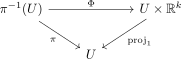
such that is locally trivialisable. That is, for every point , there is an open neighbourhood of , a natural number , and a homeomorphism \newcommand{\R}{\mathbb{R}}\Phi \colon \pi^{-1}(U) \to U \times \R^{k} that for all , is a linear isomorphism onto . In other words, the following diagram commutes:
Remark
Intuitively, the local trivialisation means that locally, the vector bundle doesn’t twist or bend in a complicated way. So, local trivialization is the property that allows us to study the vector bundle piece by piece, using the familiar structure of product spaces in each piece, even if the entire bundle has a more complex, “twisted” global structure.
Transition Map
On an -manifold, given two coordinate charts the coordinate change induces a corresponding change of basis: And we can identify the change of basis matrix as a smooth map .
Section
A section of a vector bundle over through is essentially an assignment to choose one vector from each fiber of the bundle in a smooth manner, such that .
e.g. A vector bundle over a manifold with section and fibers :

Proposition
Frame of a Vector Bundle
Let be a vector bundle on a smooth manifold . A local frame over an open subset , is a set of smooth sections of such that for every , the vectors form a basis of the fiber .
Remark
A frame provides a way to trivialise the bundle locally, giving a smooth choice of basis for each vector space fiber over an open set of the base manifold.
Subbundle
is called a subbundle of if for every , the fiber is a linear subspace of the fiber .
Quotient Bundle
Given a subbundle of a vector bundle , the quotient bundle is the vector bundle over whose fibers are the quotient spaces , for all .
Dual Bundle
The dual bundle of a vector bundle over is the vector bundle over whose fibers are the dual spaces to the fibers of .
Pullback Bundle & Pullback Section
Suppose is a vector bundle on a manifold , and is a local diffeomorphism map. Then the pullback bundle is a vector bundle over whose fibers are the pullbacks of the fibers of . That is, for each , the fiber is defined as . A section of induces a section of by
Lemma
A continuous map between vector bundles over the same base space is an isomorphism if it takes each fiber to the corresponding fiber by a linear isomorphism.
Proposition
The only spheres with trivial tangent bundles are .
Bundle Operations
Direct Sum of Vector Bundles
Given two vector bundles and over the same base space , the direct sum of and is defined as the space There is then a projection sending to the point .
Remark
The direct sum of two trivial bundles is again a trivial bundle, clearly, but the direct sum of nontrivial bundles can also be trivial. For example consider the direct sum of tangent and normal bundle to in .
Inner Product on a Vector Bundle
An inner product on a vector bundle is a map which restricts in each fiber to an inner product, a positive definite symmetric bilinear form.
if is compact Hausdorff or more generally paracompact.
An inner product exists for a vector bundle
Proposition
If is a vector bundle over a paracompact base and is a vector subbundle, then there is a vector subbundle such that .
Tensor Product Bundle
Let and be vector bundles. The tensor product bundle is defined by: A cover of and homeomorphisms induced by local trivializations of .